PCF vs LCA in Metals & Mining: why carbon transparency needs more than a life-cycle study
The market wants to compare. LCA is not built to facilitate this.
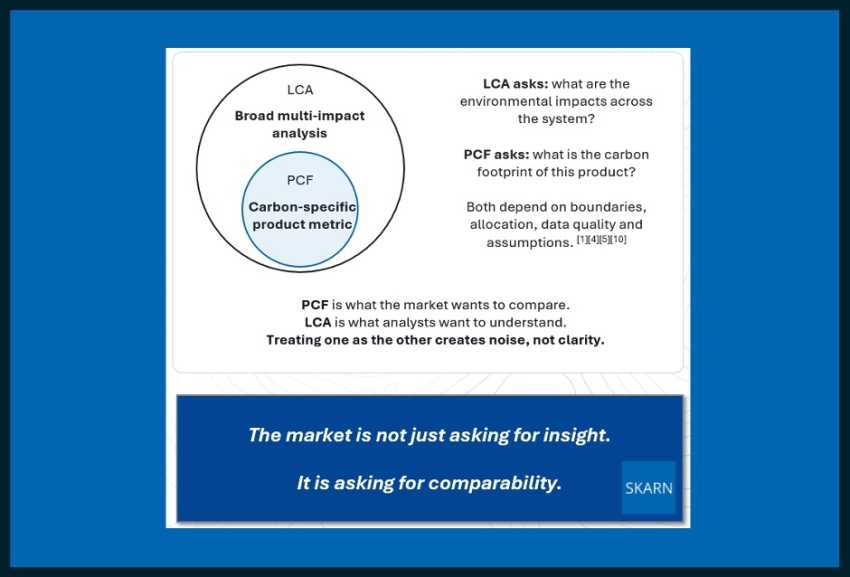
PCF and LCA are related, but they are not interchangeable when the commercial job is comparability.
In looking more closely at some of our clients' workflows and use cases for our data, Skarn has been digging deep into two widely used methodologies: life-cycle analysis (LCA) and product carbon footprinting (PCF). This has revealed some important considerations that have a significant impact on trust, cost and friction within the supply chain.
PCF and LCA share the same methodological foundations. Both depend on choices around system boundaries, functional unit, allocation, data quality, background datasets and reporting. That is precisely why they should not be treated as self-explanatory. Two studies can appear to address the same product while producing results that are not comparable because the design logic differs underneath.
The problem begins when a broad analytical framework - LCA - is expected to behave like a market comparison metric. LCA is highly useful for explaining the environmental impacts of a system but it is not built to deliver like-for-like comparability between reporting entities and assets.
In metal markets, expectations are moving faster than methodology alignment - creating a growing gap between carbon claims and usable comparison. When studies are not comparable, carbon intensity data becomes harder to use in customer conversations, harder to defend commercially, and harder to translate into credible differentiation.
LCA remains a powerful tool for hotspot analysis, trade-off assessment, process optimisation, or wider sustainability strategy. PCF is narrower by design. It applies life-cycle logic to a more specific metric: the greenhouse gas emissions associated with a product. That distinction matters because buyers, commercial teams, traders and downstream customers are not usually asking for a full life-cycle narrative. They are asking for a carbon number they can understand, challenge and compare.
A life-cycle study can be methodologically valid and still be unfit for like-for-like comparison across reporting entities and assets. Results can move materially depending on system boundaries, treatment of recycling, co-product allocation, electricity modelling, geographical representativeness, reporting period, data vintage and interpretation rules. Two studies can both be correct within their own design logic and still fail to provide a level playing field.
That is the commercial problem now emerging in the copper market, in which participants increasingly seek to compare product carbon performance across different producers, supply chains and production routes. Yet the current reliance on standalone LCAs is not solving that problem. It is generating carbon claims, but not carbon clarity. Copper is where this issue becomes impossible to ignore. It sits at the centre of electrification narratives, is increasingly exposed to scrutiny on primary versus secondary routes and is moving toward a world where carbon claims will need to stand up commercially, not just technically.
Most companies are trying to use one study for three different jobs: internal hotspot analysis, carbon communication, and entity-to-entity comparison. If the objective is internal hotspot analysis, trade-off assessment, or broader sustainability strategy, LCA remains highly valuable. If the objective is carbon communication, product positioning, customer engagement, or carbon-focused procurement discussions, PCF is usually the more decision-useful format. If the objective is comparison across assets, producers or brands, neither a generic LCA nor a standalone PCF is enough unless the rules of comparison are aligned.
Comparability depends on clear system boundaries, transparent allocation treatment, disciplined handling of producer-submitted versus estimated data, documented assumptions and a review process that can withstand challenge. The market does not need more carbon numbers in isolation. It needs confidence that different numbers are comparable across the global mining industry. Copper is likely to be one of the first commodities where this distinction becomes commercially unavoidable.
What does this mean for functions within supply chain businesses? Sustainability leads should stop treating LCA as a proxy for benchmark-ready comparison. Commercial leads need to accept that customer-facing carbon claims need comparability, not just technical validity. The C-suite need to be aware that if your carbon data cannot support credible differentiation, it will not support pricing power.
Join in on this and more industry conversations at Skarn Intelligence on LinkedIn
MORE FROM SKARN

About Us
Skarn Associates is the market leader in quantifying and benchmarking asset-level greenhouse gas emissions, energy intensity, and water use across the mining sector.
Latest bulletin